
Published: 2025-04-29 10:17
In the Symposium Module II, topic, "Risk Management and Full-Chain Legal Services of International Culture and Entertainment Industry" of the High-Level Dialogue of the International Commercial Dispute Prevention and Settlement Organization (ICDPASO), several legal experts from universities, enterprises, dispute settlement institutions and associations were invited to participate in sharing and exchanges. DONG Yuanyuan, Director of Beijing Lawyers Association Culture Tourism Media and Sports Law Professional Committee and Senior partner of Tiantai Law Firm, presided over this Module.
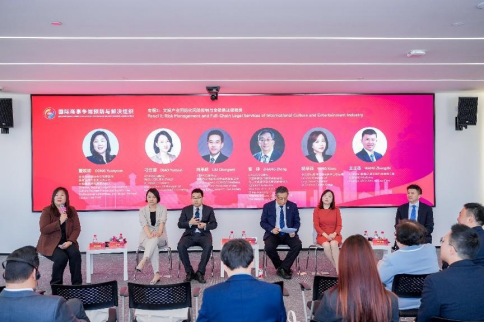
ZHANG Zheng, lCDPASO Arbitrator, Vice President of the China Academy of Arbitration Law, and Senior Partner of the Dentons Law Firm, pointed out that in international arbitration in the field of culture and entertainment, cultural differences are a problem that cannot be ignored. In practice, there are different understandings of the scope of expected return, the connotation of force majeure and the management system of cultural market. These problems need to be gradually solved through the design and innovation of arbitration rules,the choice of the applicable Law and the integration of culture.
LIU Chengwei, lCDPASO Mediator, Professor at China University of Political Science and Law and Executive Vice President of the Beijing Entertainment Law Society, stated that the entertainment industry has rapidly flourished under policy incentives, but also faces strict regulatory constraints, requiring a balance between the economic and social benefits of the entertainment industry. With the rapid development of the entertainment industry, new legal service demands have also emerged, such as investment dispute resolution, illegal and unethical regulation, public opinion management, crisis public relations, content review, etc. The value of these services may be higher than traditional legal services.
YANG Xinru, General Manager of Legal Service Center at Chinese Online Group, proposed that short videos and short dramas commercial act “drives this trade” have shown outstanding performance in overseas markets, and the right to speak of Chinese cultural and entertainment products is increasing. With the development of China's cultural and entertainment industry, it is necessary to establish more cutting-edge industry rules in aspects such as content production and publish on Internet platforms. In addition, in the international cultural and entertainment industry, the selection of contract clauses and dispute settlement mechanisms is of vital importance. Dispute settlement institutions need to be equipped with arbitration experts with industry experience and set reasonable arbitration costs to attract and be suitable for commercial entities within the industry.
DIAO Yunyun, lCDPASO Mediator and Deputy General Manager of Legal Affairs Department of Tencent, pointed out that according to the data in 2023, the scale of China's content industry has reached 1.6 trillion yuan, but its global market share is relatively low and it faces fierce competition. The copyright infringement involved in short video platforms and shared drives services has caused a certain impact on genuine content, leading to difficulties in the revenue of genuine content and a decline in the enthusiasm for investment. There is an imbalance in platform technology in terms of the dissemination and protection of infringing content, and it is necessary to improve the law and enhance the responsibility of platforms to jointly combat piracy and protect the legitimate rights and interests of legitimate content.
WANG Zhengzhi, lCDPASO Mediator and Director of Globe-Law Law Firm, stated that attention should be paid to the issues of identifying intellectual property rights of virtual characters, the formats of variety shows, and so on. Moreover, whether the use of existing works during the process of "data feeding" and AI cultivation falls within the scope of "fair use" as defined in the Copyright Law, and the protection of content generated by AI under the Copyright Law are directions that legal practitioners can focus on for research.