
Published: 2026-02-27 00:00
In international commercial arbitration, the efficiency advantage brought by the principle of “arbitration award shall be final and binding” is inseparable from the timeliness of the Arbitral Tribunal’s decision-making. How to scientifically and reasonably set and manage the time limit for making an award has become a crucial issue in balancing arbitration efficiency and award quality. Article 36 of the ICDPASO Commercial Arbitration Rules establishes a system for the time limit for making the award that is both clearly guided and flexible. It not only provides parties with clear expectations regarding the timeline but also reserves the necessary space for the Arbitral Tribunal to handle complex cases. Furthermore, it serves as an important regulatory guarantee for the ICDPASO Arbitration Court, as the arbitral administering institution, to ensure the efficient and orderly progress of proceedings.
I. Rule Text
Article 36. Time Limit for the Award
1. The Arbitral Tribunal shall make an arbitral award within four (4) months from the date of closure of hearing. If the time limit needs to be extended due to special circumstances, the Arbitral Tribunal or the authorized presiding arbitrator shall submit the extension to the Court of Arbitration for approval.
2. The aforesaid time limit does not include the period during which the arbitral proceedings are suspended, the time for appraisal, evaluation, audit, testing and expert consultation on special issues, and the time for out-of-court settlement at the joint request in writing by the parties to the Arbitral Tribunal.
Ⅱ. The Main Purpose and Significance Analysis of “Time Limit for the Award”
This article aims to establish a timeframe for rendering awards that balances certainty and flexibility. At an institutional level, it urges the efficient progress of arbitration proceedings, prevents undue delay, and ensures that parties obtain a final resolution of their dispute within a reasonable period, thereby effectively realizing the value of efficiency in arbitration.
First, this provision serves as the procedural anchor for the efficiency value of commercial arbitration. By clearly setting the time limit for making the award at four months from the date of closure of hearing, it establishes a predictable schedule for the entire arbitration process, embodying the concretization and proceduralization of the efficiency promise of the arbitration system.
Second, this provision balances procedural predictability and procedural fairness. The clear time limit acts as a procedural constraint on the Arbitral Tribunal, preventing delays in rendering the award caused by the Arbitral Tribunal itself, which could harm the parties’ interests. Simultaneously, by setting clear exclusions from the time limit and a conditional extension mechanism, it avoids the “one-size-fits-all” approach for all cases. This reserves ample space for party autonomy and the handling of complex cases, ensuring that the Arbitral Tribunal, when faced with legitimate procedural needs or parties actively seeking settlement, does not have to rule hastily or hinder settlement due to time pressure. This essentially safeguards deeper procedural and substantive fairness.
Third, this provision grants the the Court of Arbitration a managerial function. On one hand, the Arbitration Court’s guidance on arbitrator diligence includes promptly hearing the dispute and clarifying the closure date of the hearing within the procedural timetable or at an appropriate procedural stage. On the other hand, the rules grant the Arbitral Tribunal the right to initiate a request for extending the time limit for making the award, while vesting the decision-making power with the the Court of Arbitration.
Ⅲ. Analysis of Article 36, Paragraph 1: Time Limit for the Award, Commencement Date and Extension Mechanism
This paragraph establishes the fundamental principle for the time limit, starting point and the exceptional procedure for extension in ordinary procedure.
First, the principle for the time limit is four months. This is the timeframe within which the Arbitral Tribunal must complete all work, including final deliberations, drafting, scrutiny, and signing of the award. The length of this period is a balanced product of international arbitration practice, considering both the need for the tribunal to have sufficient time to deliberate on the dispute and responding to commercial parties’ urgent demands for arbitration efficiency.
Second, the time limit commences from the date of closure of hearing. This means the parties have exhausted their rights to present submissions and arguments, and the case materials are finalized. It is an irreversible procedural milestone. At this point, the case enters the private deliberation phase of the Arbitral Tribunal.
Finally, the proviso “if the time limit needs to be extended due to special circumstances” provides the necessary flexibility for the Arbitral Tribunal to handle complex cases. “Special circumstances” refer to objective and reasonable reasons that not arise from the Arbitral Tribunal itself. For example, in complex cases involving extensive evidence requiring repeated deliberations, the four-month period might indeed be insufficient; or there might be a need to await the outcome of another related case that has a decisive impact on the award. This paragraph allows the Arbitral Tribunal or the authorized presiding arbitrator to apply to the Court of Arbitration for an extension when necessary, thereby ensuring the quality of the award and avoiding sacrificing the depth of consideration due to the time limit. While providing flexibility, this paragraph also imposes corresponding constraints. On one hand, the request for extending the time limit should be decided collectively by the Arbitral Tribunal and submitted in the Arbitral Tribunal’s name, or submitted by the authorized presiding arbitrator. On the other hand, the Court of Arbitration holds the decision-making power on whether to grant the extension. The Court of Arbitration will exercise its discretion, examining whether the reasons are indeed special and necessary, and whether the requested extension period is reasonable. This mechanism ensures the seriousness of time limit extensions, prevents procedural abuse, and reflects the Arbitration Court’s supervisory role over the procedural progress.
From a comparative law perspective, different institutional arbitration rules have varying provisions regarding the time limit for making awards, the commencement date, the method of extension in different procedures. The following compares the relevant provisions concerning different procedures of the ICC Arbitration Rules, the UNCITRAL Arbitration Rules, the SIAC Rules, the LCIA Arbitration Rules, the AAA Commercial Arbitration Rules, the ICDR International Arbitration Rules, the SCC Arbitration Rules and the HKIAC Administered Arbitration Rules:
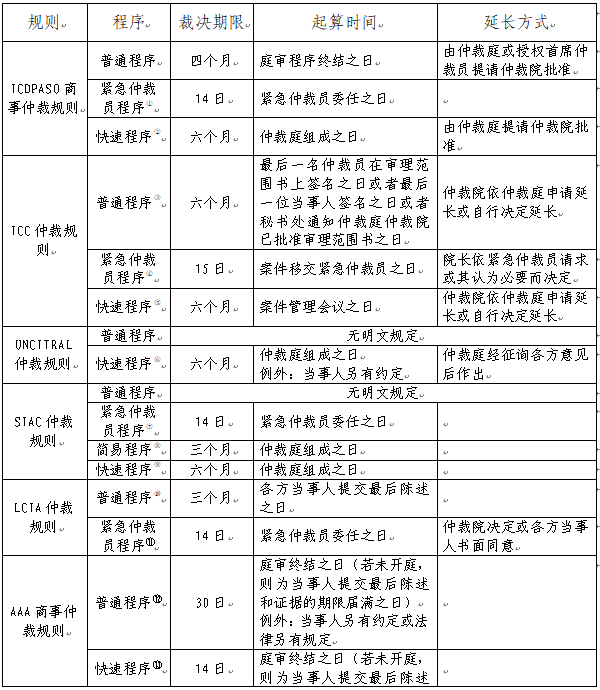
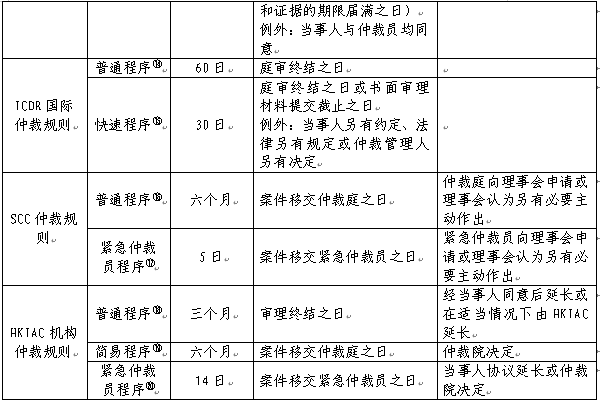
It can be observed that for ordinary procedures, the four-month time limit stipulated in the ICDPASO Commercial Arbitration Rules is relatively short compared to others. Using the “date of closure of hearing” as the commencement point, different from standards like “date of constitution of the Arbitral Tribunal”, “of the date the case was referred to the Arbitral Tribunal”, or “date of last submission from the parties”, is more favorable for particularly complex cases requiring multiple hearings and rounds of legal arguments. Calculating the time limit from the closure of the hearing safeguards the time for the substantive hearing phase, ensuring the tribunal does not have to sacrifice the depth of case consideration while pursuing efficiency. This reflects ICDPASO’s procedural philosophy of valuing the substantive hearing phase and aligning with arbitration practice. The method of extension requiring “approval of the Court of Arbitration” establishes procedural supervision, preventing arbitrary extensions. Simultaneously, the phrasing “special circumstances” and “needs to be extended” sets a relatively high threshold, preventing procedural abuse.
Regarding the emergency arbitrator procedure, its core value is providing parties with timely interim relief before the constitution of the Arbitral Tribunal. Therefore, similar to other institutions, ICDPASO also sets an extremely short time limit, requiring a decision within 14 days from the date the emergency arbitrator accepts the appointment. Regarding the expedited procedure, it applies to cases with smaller dispute amounts or relatively simple facts, aiming to save costs and time through simplified procedures. ICDPASO adopts the internationally common six-month period, commencing from the date of constitution of the Arbitral Tribunal. This ensures the expedited procedure enters the “fast track” as soon as the Arbitral Tribunal is in place to perform its duties, avoiding front-end procedural delays consuming the overall time, which aligns with the legislative intent of expedited procedures. Regarding the extension mechanism for the time limit, ICDPASO is consistent with institutions like ICC and SCC, requiring approval from the Court of Arbitration for any extension, reflecting the arbitral administering organization’s supervision and control over procedural progress, preventing the expedited procedure from losing its efficiency advantage due to arbitrary extensions.
Ⅳ. Analysis of Article 36, Paragraph 2: Matters Excluded from the Time Limit
Compared to the arbitration rules of other institutions, the ICDPASO Commercial Arbitration Rules comprehensively and specifically list several procedural periods that are not counted within the four-month time limit for making an award, enhancing the operability and predictability of the rules.
First, the period during which the arbitral proceedings are suspended. When the arbitration proceedings are suspended due to legal or agreed reasons, the calculation of the time limit for the award is paused, as the Arbitral Tribunal cannot carry out any substantive work during this period. After the proceedings resume, the time limit continues from the point it had reached before the suspension.
Second, the time for handling special issues, including the time for appraisal, evaluation, audit, testing, and expert consultation. These procedures are essential steps in many cases involving specialized fields, such as project quality appraisal, value assessment, or clarification of technical standards. As they rely on the independent work of third-party professional institutions, the time required is not directly within the control of the Arbitral Tribunal. Excluding this period ensures that the Arbitral Tribunal is not forced to render an award before obtaining crucial expert opinions.
Third, the time for out-of-court settlement by the parties. Allowing parties to settle out of court reflects respect for party autonomy. Not counting the settlement period within the time limit for making the award encourages parties to use the information exchange and position clarification during the arbitration process to seek commercial settlements, without worrying that settlement negotiations will consume the award-making time and create pressure. If the settlement succeeds, the case concludes smoothly; if it fails, the proceedings and time limit seamlessly resume from the point of interruption. This design combines the adjudicative function of arbitration with the function of promoting settlement.
All the above-mentioned matters excluded from the time limit for the award are either objective or consensual. They are either objective procedures beyond the Arbitral Tribunal’s control or actions based on the mutual will of the parties. Excluding this time ensures that the four-month period is used purely for the Arbitral Tribunal’s deliberations and award-drafting work, making the time limit provision fairer and more reasonable.
Ⅴ. Conclusion
Stipulating the time limit for making the award in commercial arbitration aims to achieve a balance between arbitration efficiency and procedural flexibility while ensuring the fairness of the award. This provision serves a fundamental goal to ensure that every dispute submitted to ICDPASO can receive a high-quality final award made after careful deliberation within a reasonable timeframe, thereby fulfilling ICDPASO’s service mission – providing accessible, independent, efficient and trusted dispute prevention and resolution services to parties from all over the world.
①ICDPASO Commercial Arbitration Rules (2022), Art.25.5, which provides that: “The emergency arbitrator shall make relevant decisions and explain the reasons within fourteen (14) days from the date of acceptance of appointment. The parties shall abide by the decision made by the emergency arbitrator.” ②ICDPASO Commercial Arbitration Rules (2022), Art.46.5, which provides that: “The Arbitral Tribunal shall make a final award within six (6) months as of the date of its formation; if an extension is necessary under special circumstances, it may be submitted to the Court of Arbitration for approval.” ③ICC Arbitration Rules (2021), Art. 31, which provides that: “The time limit within which the arbitral tribunal must render its final award is six months. Such time limit shall start to run from the date of the last signature by the arbitral tribunal or by the parties of the Terms of Reference or, in the case of application of Article 23(3), the date of the notification to the arbitral tribunal by the Secretariat of the approval of the Terms of Reference by the Court. The Court may fix a different time limit based upon the procedural timetable established pursuant to Article 24(2). The Court may extend the time limit pursuant to a reasoned request from the arbitral tribunal or on its own initiative if it decides it is necessary to do so.” ④ ICC Arbitration Rules (2021), Appendix V - Emergency Arbitrator Rules, Art. 6.4, which provides that: “The Order shall be made no later than 15 days from the date on which the file was transmitted to the emergency arbitrator pursuant to Article 2(3) of this Appendix. The President may extend the time limit pursuant to a reasoned request from the emergency arbitrator or on the President’s own initiative if the President decides it is necessary to do so.” ⑤ICC Arbitration Rules (2021), Appendix VI - Expedited Procedure Rules, Art. 4.1, which provides that: “The time limit within which the arbitral tribunal must render its final award is six months from the date of the case management conference. The Court may extend the time limit pursuant to Article 31(2) of the Rules.” ⑥UNCITRAL Expedited Arbitration Rules, Art. 16: 1. The award shall be made within six months from the date of the constitution of the arbitral tribunal unless otherwise agreed by the parties. 2. The arbitral tribunal may, in exceptional circumstances and after inviting the parties to express their views, extend the period of time established in accordance with paragraph 1. The extended period of time shall not exceed a total of nine months from the date of the constitution of the arbitral tribunal. 3. If the arbitral tribunal concludes that it is at risk of not rendering an award within nine months from the date of the constitution of the arbitral tribunal, it shall propose a final extended time limit, state the reasons for the proposal, and invite the parties to express their views within a fixed period of time. The extension shall be adopted only if all parties express their agreement to the proposal within the fixed period of time. 4. If there is no agreement to the extension in paragraph 3, any party may make a request that the Expedited Rules no longer apply to the arbitration. After inviting the parties to express their views, the arbitral tribunal may determine to continue to conduct the arbitration in accordance with the UNCITRAL Arbitration Rules. ⑦EMERGENCY ARBITRATOR PROCEDURE of SIAC Rules (2025), Art. 17, which provides that: “The Emergency Arbitrator shall have the power to order or award any interim relief that the Emergency Arbitrator deems necessary. The Emergency Arbitrator shall make the order or award within 14 days from the date of the Emergency Arbitrator’s appointment unless the Registrar extends the time. No order or award shall be made by the Emergency Arbitrator until it has been approved by the Registrar in accordance with Rule 53.” ⑧STREAMLINED PROCEDURE of SIAC Rules (2025), Art. 15, which provides that: “The final award shall be made within 3 months from the date of constitution of the Tribunal, unless the Registrar extends the time for making such final award.” ⑨EXPEDITED PROCEDURE of SIAC Rules (2025), Art. 6, which provides that: “The final award shall be made within 6 months from the date of constitution of the Tribunal, unless the Registrar extends the time for making such final award.” ⑩LCIA Arbitration Rules (2023), Art. 15.10, which provides that: “In any event, the Arbitral Tribunal shall seek to make its final award as soon as reasonably possible and shall endeavour to do so no later than three months following the last submission from the parties (whether made orally or in writing), in accordance with a timetable notifed to the parties and the Registrar as soon as practicable (if necessary, as revised and re-notifed from time to time). When the Arbitral Tribunal (not being a sole arbitrator) establishes a time for what it contemplates shall be the last submission from the parties (whether written or oral), it shall set aside adequate time for deliberations (whether in person or otherwise) as soon as possible after that last submission and notify the parties of the time it has set aside.” ⑪LCIA Arbitration Rules (2023), Art. 9.8, which provides that: “The Emergency Arbitrator shall decide the claim for emergency relief as soon as possible, but no later than 14 days following the Emergency Arbitrator’s appointment. This deadline may only be extended by the LCIA Court in exceptional circumstances (pursuant to Article 22.5) or by the written agreement of all parties to the emergency proceedings. The Emergency Arbitrator may make any order or award which the Arbitral Tribunal could make under the Arbitration Agreement; and, in addition, may make any order adjourning the consideration of all or any part of the claim for emergency relief to the proceedings conducted by the Arbitral Tribunal (when formed).” ⑫AAA Commercial Arbitration Rules (2022), Art. 47, which provides that: “The award shall be made promptly by the arbitrator and, unless otherwise agreed by the parties or specified by law, no later than 30 calendar days from the date of closing the hearing, or, if oral hearings have been waived, from the due date set for receipt of the parties’ final statements and proofs.” ⑬Expedited Procedures of AAA Commercial Arbitration Rules (2022), Art. 9, which provides that: “Unless otherwise agreed by the parties and arbitrator, the award shall be rendered not later than 14 calendar days from the date of the closing of the hearing or, if oral hearings have been waived, from the due date established for the receipt of the parties’ final statements and proofs.” ⑭ICDR International Arbitration Rules (2021), Art. 33.1, which provides that: “Awards shall be made in writing by the arbitral tribunal and shall be final and binding on the parties. The tribunal shall make every effort to deliberate and prepare the award as quickly as possible after the hearing. Unless otherwise agreed by the parties, specified by law, or determined by the Administrator, the final award shall be made no later than 60 days from the date of the closing of the hearing pursuant to Article 30. The parties shall carry out any such award without delay and, absent agreement otherwise, waive irrevocably their right to any form of appeal, review, or recourse to any court or other judicial authority, insofar as such waiver can validly be made. The tribunal shall state the reasons upon which an award is based, unless the parties have agreed that no reasons need be given.” ⑮International Expedited Procedures of ICDR International Arbitration Rules (2021), Art. E-10, which provides that: “Awards shall be made in writing and shall be final and binding on the parties. Unless otherwise agreed by the parties, specified by law, or determined by the Administrator, the award shall be made not later than 30 days from the date of the closing of the hearing or from the time established for final written submissions.” ⑯SCC Arbitration Rules (2023) Art. 43, which provides that: “The final award shall be made no later than six months from the date the case was referred to the Arbitral Tribunal pursuant to Article 22. The Board may extend this time limit upon a reasoned request from the Arbitral Tribunal or if otherwise deemed necessary.” ⑰SCC Arbitration Rules (2023), Appendix II - Emergency arbitrator, Art. 8.1, which provides that: “Any emergency decision on interim measures shall be made no later than five days from the date the application was referred to the emergency arbitrator pursuant to Article 6 of this Appendix. The Board may extend this time limit upon a reasoned request from the emergency arbitrator, or if otherwise deemed necessary.” ⑱HKIAC Administered Arbitration Rules (2024), Art. 31.2, which provides that: “Once the proceedings are declared closed, the arbitral tribunal shall inform HKIAC and the parties of the anticipated date by which an award will be communicated to the parties. The date of rendering the award shall be no later than three months from the date when the arbitral tribunal declares the entire proceedings or the relevant phase of the proceedings closed, as applicable. This time limit may be extended by agreement of the parties or, in appropriate circumstances, by HKIAC.” ⑲HKIAC Administered Arbitration Rules (2024), Art. 42.2: When HKIAC, after considering the views of the parties, grants an application made pursuant to Article 42.1, the arbitral proceedings shall be conducted in accordance with an Expedited Procedure based upon these Rules, subject to the following changes: ...... (f) subject to any lien, the award shall be communicated to the parties within six months from the date when HKIAC transmitted the case file to the arbitral tribunal. In appropriate circumstances, HKIAC may extend this time limit; ...... ⑳HKIAC Administered Arbitration Rules (2024), Schedule 4 Emergency Arbitrator Procedure, Art. 12, which provides that: “Any decision, order or award of the emergency arbitrator on the Application (the “Emergency Decision”) shall be made within 14 days from the date on which HKIAC transmitted the case file to the emergency arbitrator. This time limit may be extended by agreement of the parties or, in appropriate circumstances, by HKIAC.”