Published: 2026-08-20 09:06
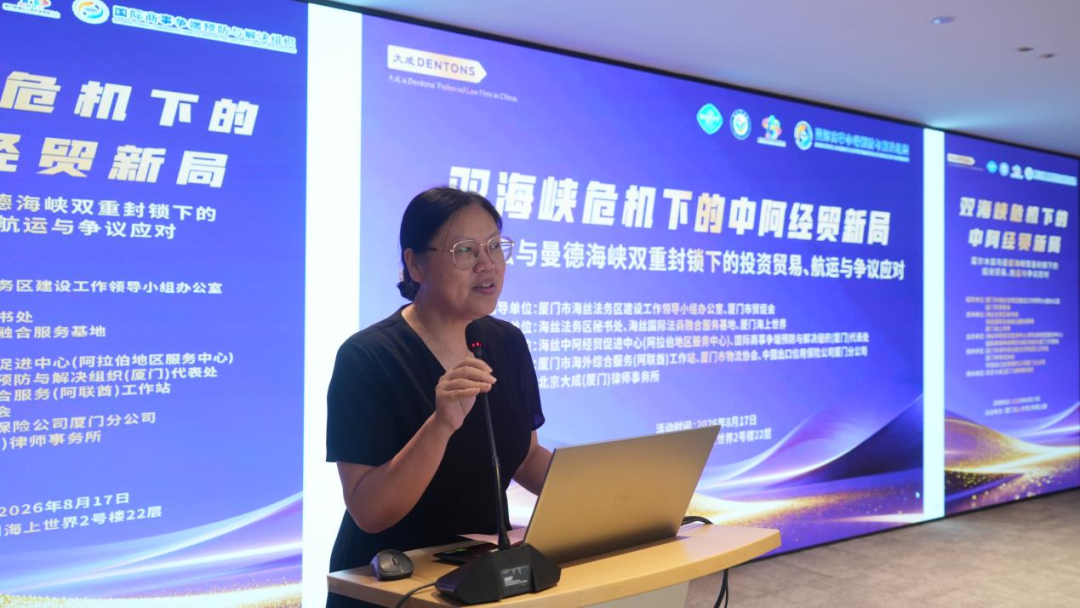
Xiamen, August 17, 2026 - The event themed New Landscape of China-Arab Economic and Trade Relations amid the Two Straits Crisis — Investment, Trade, Shipping and Dispute Resolution under the Dual Blockade of the Strait of Hormuz and the Mandab Strait, co-hosted by the International Commercial Dispute Prevention and Settlement Organization (ICDPASO) (Xiamen) Representative Office and China-Arabic Center for the Promotion of Economy and Trade of Maritime Silk Road (Arab Region Service Center), concluded successfully.
At the opening session, Ms. WANG Qing, Director of the Legal Department of the China Council for the Promotion of International Trade Xiamen Committee, noted that the event closely responded to enterprises’ practical needs in exploring the Middle East market. She called on all parties to strengthen law-business collaboration and resource matchmaking, providing professional support for enterprises in preventing risks in cross-border operations.
At the event, drawing on typical cases, the ICDPASO (Xiamen) Representative Office introduced the one-stop dispute prevention and resolution services with a focus on dispute prevention, and recommended that enterprises incorporate ICDPASO’s Model Clauses for Dispute Prevention and Commercial Arbitration into cross-border contracts as a comprehensive risk control package. Enterprises may leverage dispute prevention services including good offices and consultation to improve dispute handling efficiency, and resort to arbitration proceedings when necessary to obtain enforceable arbitral awards.
During the thematic sharing session, Mr. WU Shaobo, member of China-Arabic Center for the Promotion of Economy and Trade of Maritime Silk Road and Partner of Dacheng Xiamen Office, elaborated on challenges and opportunities faced in China-Arab trade, shipping and investment amid the two straits crisis. He systematically analyzed the impact of compound navigation risks in the Strait of Hormuz and the Mandab Strait on international supply chains and enterprises’ cross-border operations. He suggested that enterprises improve their risk prevention and control systems in areas including contract clauses, logistics routes, insurance arrangements and investment compliance, while seizing cooperation opportunities arising from the development of infrastructure, new energy and digital economy in the Middle East.
Ms. HUANG Dongxia, member of China-Arabic Center for the Promotion of Economy and Trade of Maritime Silk Road and Partner of Dacheng Xiamen Office, focused on charter business practices with an in-depth interpretation of war risk clauses, safe port clauses, demurrage and contract termination. She advised enterprises to clarify arrangements concerning war risks, force majeure, insurance premium and alternative ports at the contracting stage, and to conduct risk assessments, notification communication and evidence preservation throughout contract performance.
Ms. CHENG Niya from China Export & Credit Insurance Corporation (SINOSURE) Xiamen Branch analyzed opportunities and risks in the Middle East market from the perspective of SINOSURE. She reminded enterprises to pay close attention to geopolitical conflicts, international sanctions and buyer credit risks, and make full use of credit insurance tools for sound market expansion.
Mr. ZHENG Xixin, initiator of China-Arabic Center for the Promotion of Economy and Trade of Maritime Silk Road, shared insights into the legal system of the United Arab Emirates, the principles of Islamic law, as well as local religious culture and business customs,. He urged enterprises to respect local legal norms and cultural taboos and strengthen compliance awareness.
In addition, Ms. ZHANG Xueqi from ITG Resources FZCO shared enterprises’ practices in responding to regional logistics fluctuations via video. She sorted out risks including change of port of call, cargo damage, goods rejection and cargo abandonment, and proposed improving emergency response plans and strengthening supply chain coordination.
The event attracted representatives from cross-border investment and trade enterprises, foreign-related legal service institutions, industry associations and other sectors.
By HUANG Huazhen, GU Wanning, CUI Tong